
*Minor spoilers for Big Walk to follow
Big Walk launched in August 2026, and discussion quickly centered on how House House explored the theme of communication through its many puzzles and challenges. Most puzzles require you and your partners to discuss strategy, assign roles and execute on your plan. Many take away your ability to communicate verbally by using soundproof rooms or distances too large for the game’s proximity voice chat. Some do the opposite, taking away the ability for one character to see, forcing them to rely on voiced instructions from others. There’s even one particularly famous challenge that isn’t even a puzzle- it’s just a room (the setting of the very good Big Talk series) where all you need to do is chill for a few minutes and talk with your friends.
There has been a lot of great writing about the ways that Big Walk creates magical moments with your friends (and ideally you should be playing with friends, not randos). I’d encourage you to read wonderful pieces like Jesse Vitelli’s “How a Single Big Walk Puzzle Perfectly Captured the Game’s Message”, Wallace Truesdale’s “Remembering That We’re All Instruments in Big Walk”, Rebekah Valentine’s review, Phoenix Simms’ “Big Heterotopia” and Dayten Rose’s “Big Walk Lights the Way for Non-Toxic Masculinity in Games” for heartfelt and sharp perspectives on how Big Walk has managed to resonate with so many friend groups. As for my contribution to the discussion, I’d like to focus on something you learn within the first few minutes of playing.
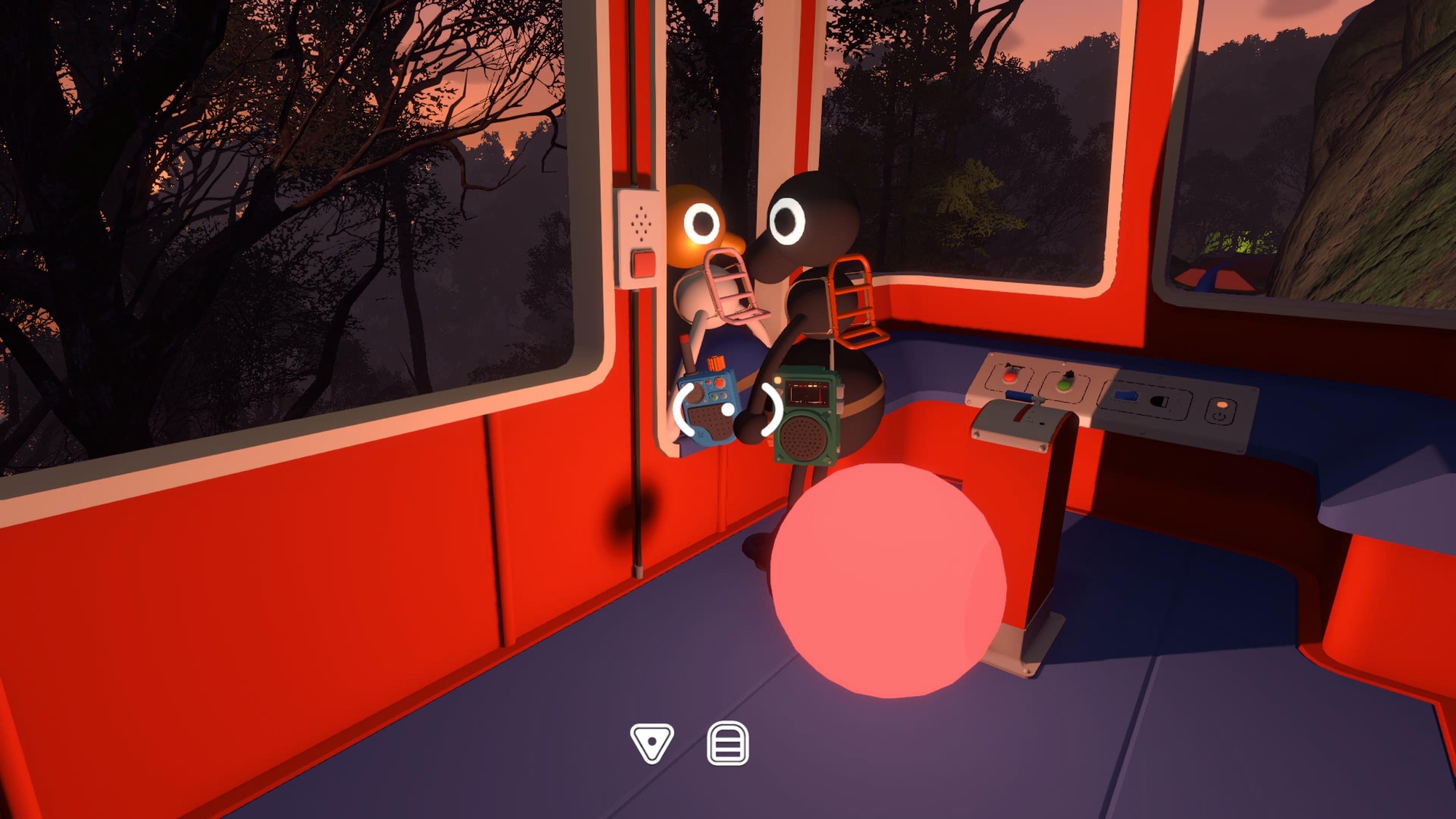
In Big Walk, you and your friends control a group of segmented weirdos. Highly stylized, vaguely insectoid guys with long, stretchy limbs. They’re goofy as hell standing still, but the fun really starts when you learn how to control them. Your “verbs” in Big Walk are very simple- you can walk, jump, crouch, pick up, kick and throw objects, and move each arm in three ways: point straight ahead, raise your arm in the air, and hold your arm out horizontally to the side. That’s it! These simple movements are a core part of solving nonverbal communication puzzles, but perhaps more impressive is how they facilitate one of the binding features of a friend group- doing dumb shit to make each other laugh, and that dumb shit turning into bits and running jokes. Big Walk highlights its slapstick fun right out of the gate as you bang cowbells and likely fall off the first cliff you find, bouncing and sliding your way down the slope, but there is so much more to the comedy than just slapstick, and that theme of communication is once again at the heart of it all.
I’m playing Big Walk with my friends Aaron, Ryan and Cody. I’ve known all three of them for over 20 years, and crucially for our Big Walk playthrough, they are three of the funniest people I’ve ever met. And while it may be trite to observe that the people you play with are as important as what you’re doing in any multiplayer game, and while it is true that the four of us would make each other laugh in any game we play, that would normally be limited to jokes in voice chat or canned emotes. Although Big Walk’s simple movements are primarily there as nonverbal communication tools, they also open up a physical brand of humor that most co-op games can’t manage.
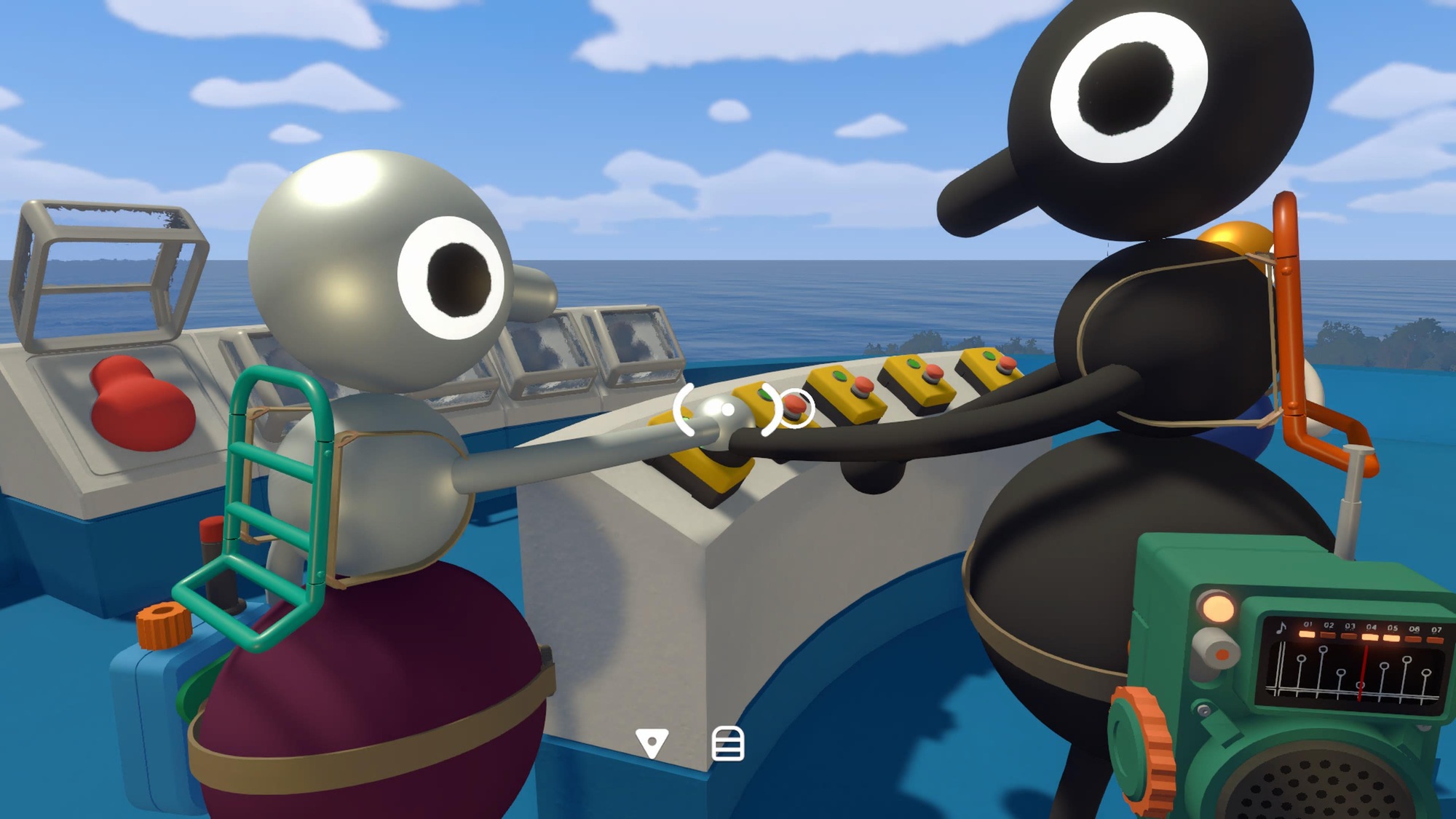
Aaron, Ryan, Cody and I have had a long-running tradition of yelling “my friend!” and going in for a hug when we see each other in person, and when we start a new session of Big Walk, we greet each other the same way, rushing in with arms wide open. Whenever someone disconnects from the game, their Walker (I guess I’m calling them Walkers) goes rigid and lies on the ground with cartoony X’s in their eyes, and the rest of us take turns crouching and pointing at them for photos. Lately we’ve taken to doing cannonballs when jumping off of high points by hitting crouch in midair. One of my favorite high school memories is a video of Ryan and Cody beatboxing and dancing that they turned in for a senior year Government class project for some reason, and any time we come across one of the music gardens in Big Walk, the four of us take some time to stop and dance- raising our arms to the sky, rhythmically pointing and gesturing, and ultimately lifting each other in the air and spinning around like figure skaters. When we found the underground rave, we *immediately* knew what to do. And when we solve a puzzle, we jump around, point to each other and run around with our arms raised in celebration. I’m consistently awed by how much expression is supported by such simple movements, and as much as I love the “Well! What is it!” gesture in Dark Souls and once thought that Goku hitting the griddy in Fortnite was funny, self-expression and comedy in Big Walk comes so organically, from the same actions you learn and use to play the game itself, leaving those others unable to hang at this level.
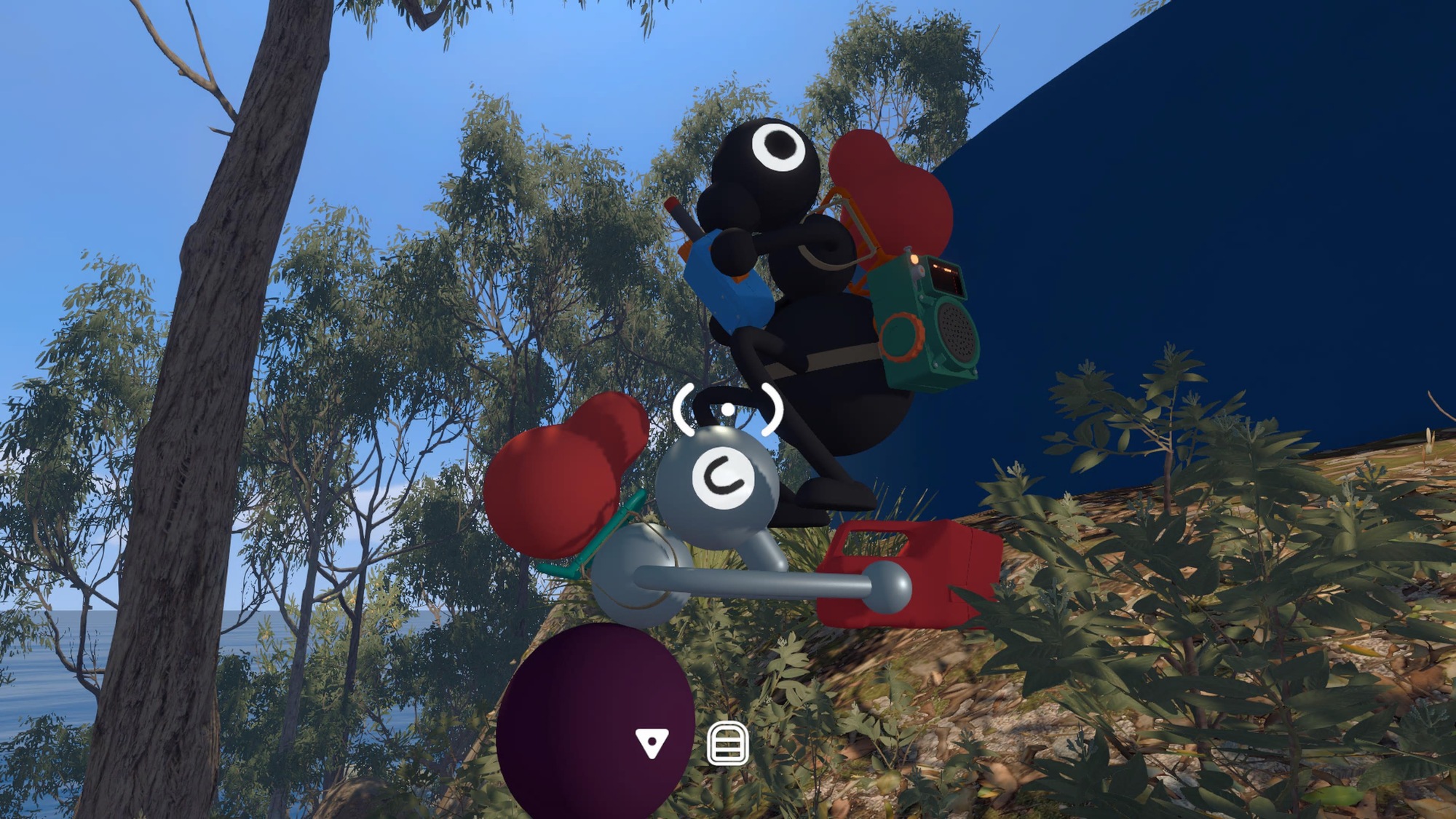
Big Walk’s items also promote running jokes in the same way, despite again being designed and placed around the island to help with puzzle solving. Walkie-talkies are supposed to help groups break free of proximity chat, but Ryan and I have mostly just dedicated ourselves to a bit where we will *only* talk when speaking into a walkie talkie, even if the group is all within earshot. Aaron has only kicked a few walkie-talkies into the ocean after hearing “uhhhh we’re gonna need you to come on back now, over, KSH!”, though we do love getting to re-enact one of our favorite quotes from Saving Silverman- “dude, you don’t need to do the KSH sound!”. And let me tell you, you haven’t lived until you’ve heard my voice, amplified through a megaphone and echoing through a canyon, belting out the entirety of Hinder’s “Lips of an Angel”. You’ll just have to trust me when I say that everyone loves it and there are absolutely no diminishing returns on that joke.
The theme of communication runs through every moment in Big Walk, and much of the discussion will rightly focus on the many ways that theme is explored via navigation and the game’s bespoke challenges, but what elevates the experience beyond “a clever, tightly designed puzzle game” is the way that Big Walk allows its players to dig deep into the stuff that lies deep at the foundation of any strong friend group. At the most basic level, we simply love being in each other’s company and finding new ways to get a laugh. House House’s master stroke was making aclever, tightly designed puzzle game *that’s also* an expressive playground for friends to hang out in. While some games feel like they need to lean one way or the other, Big Walk's ease of organic communication is the bridge between those two types of fun. The island is a wonderful space to explore, full of engaging puzzles that make us feel like a smart, effective team, but it’s also a place where we can freely move around and make each other laugh in a very natural way. Just keep me away from a megaphone. Or give in and listen for yourself- some say the chorus of "Lips of an Angel" is still echoing in that canyon to this day…and it sounds so sweet.